Maker

Nicolas Mattia

27

Chasing MOSFETs and Sleep Current: Notes From a Latching Power-Switch Build

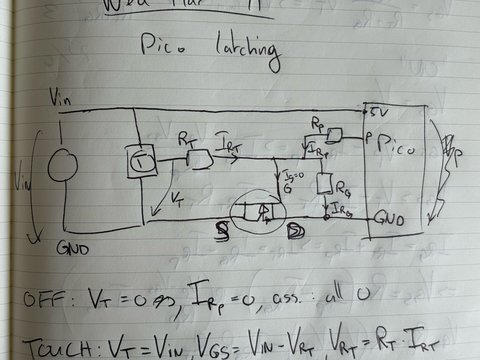
I've been trying to work out a latching power-switch circuit using a MOSFET, and it's been a humbling process. I derived an expression for Vgs that came out independent of the battery voltage, which doesn't match what I actually observe on the bench — I suspect my assumption of no voltage drop across drain and source was the mistake. I drew up a diagram of the circuit (currently with a hole where the MCU should be, since I fried mine) and shared it, but after checking things over I had to admit I simply don't understand MOSFETs yet. Along the way I found a video using a BJT and an opto-isolator instead, which avoids the voltage drop a FET gives you, and eventually concluded that PMOS + NPN is the way to go, since that's how every latching circuit I come across is built. In parallel I've been procrastinating on assembling my CurrentRanger — I thought I had a spare OLED but I don't, so I'll have to dig into the serial interface instead.
Nicolas Mattia

25

Zip-Tie Mounting for Removable PCB Attachment

I needed a way to attach a small board in a project where soldering it down to a proto board — the approach I'd used in my EUV lamp — wasn't an option, and where I wanted the board to stay serviceable, or at least removable. I settled on holding the board with zip ties through slots, and added a bit of shrink wrap for extra friction, which locked it firmly in place.

Nicolas Mattia

24

Sine waves on my solder-test displays

I was soldering some of my displays to test a new fan, then got sidetracked generating sine waves on them, and the result looks sick. The displays are amazing to work with, and the CPUs have absolutely nothing to do while driving them.

Nicolas Mattia

23

Giving Up on FreeCAD (Again): Modelling a Part in OnShape in Five Minutes

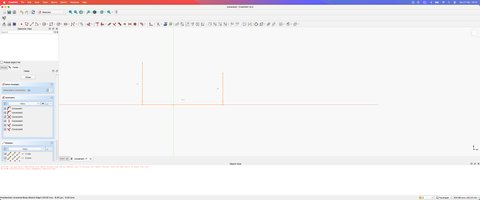
I set out to model a part in FreeCAD and spent the session squinting at my sketch trying to work out which constraint I'd applied where — I joked I needed a microscope to find it. After piling up too many errors with no apparent reason, I gave up and switched back to OnShape, where the same work took about 30 seconds, with a full part maybe five minutes away. I'm shelving FreeCAD and telling myself I'll give it another go in 2027.

Nicolas Mattia

22

Replacing the saddle on my 20 year old guitar

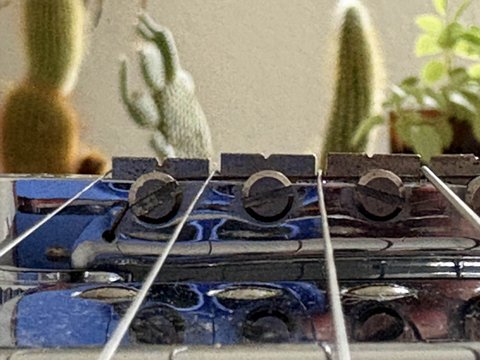
I've owned this guitar for 20 years and it never sounded right, and I was always afraid of servicing it myself, so it went through countless shops instead. I finally took the matter into my own hands and found that one of the saddle posts had been filed way too deep. Replacing the whole saddle with one from a different brand fixed the intonation, the action and a buzz all at once, and the guitar feels brand new.

Nicolas Mattia

20

LoRa link from my basement to my flat

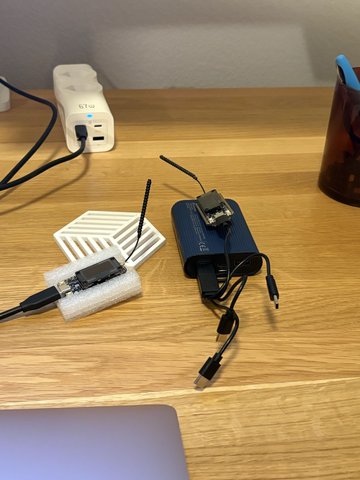
I wanted to put sensors in my basement, which is five floors away from my flat and has no network or mains access, so I looked into battery-powered ESP32s sending their readings up to me over LoRa. I had no experience with LoRa or antennas, so I bought two Heltec WiFi LoRa 32 V4 boards to get a baseline, plus a LilyGO T-Deck that was on sale, and found that ESPHome's packet transport component does exactly what I need. It works: I can report from the basement all the way up to the fourth floor.

Nicolas Mattia

17

Quick UV Lamp Build With Room to Grow

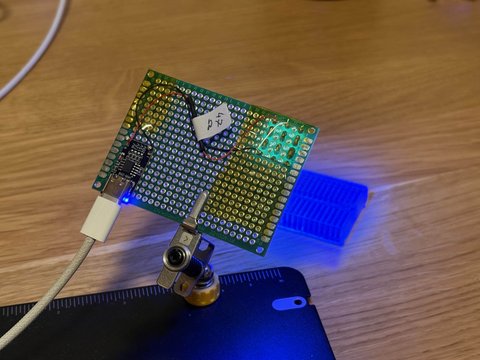
I finally got around to using one of those USB decoys that Stavros and Rudd-O are always praising, and built a quick UV lamp around it. The decoy came pre-soldered for 12V, and rather than swap out the resistor I designed a circuit around the 12V requirement instead. I'm being careful with my eyesight while using it, and I've since made the setup a bit safer.

Nicolas Mattia

13

An Expensive Hail Mary: 120 Charlieplexed LEDs on a JLCPCB Order

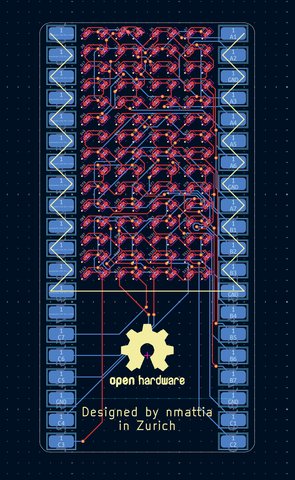
This is a PCB project built around 120 LEDs and a Pico, and it's one where I tried out a lot of new things at once, so it's a bit of a hail mary. I sent it off to JLCPCB and found out along the way that 0201 components are too small for the "cheap" assembly process, which pushed the price up to roughly $70 for 5 boards, plus $26 of Swiss tariffs and whatever the engineering request cost on top. The order was approved, which means JLC should be able to print the 0.1mm tracks and 0.3mm vias the design relies on. With 120 LEDs and twice as many connections, there's a good chance it's an expensive noop, but either way I'm calling it a learning experience.

Nicolas Mattia

12

Using LUKS on macOS: A Rewritten, Standalone Write-Up

I published a post about using LUKS on macOS, and this thread covers a revision of it. After feedback that the backup-strategy material wasn't pulling its weight, I cut it and let the piece stand on its own. The revised version was previewed on a Cloudflare Pages preview URL and is now live on my site at nmattia.com. Along the way I also got confirmation that my RSS feed is working, since a reader picked up the new post through it.

Nicolas Mattia

09

Routing a 120-LED PCB in KiCad (One Via at a Time)

I'm designing a PCB with 120 LEDs in KiCad, and I've currently got 42 of them placed and routed. It's only my second PCB, and after two weeks straight working on the circuit and the associated PIO code, routing this many parts has started to get to me — I've woken up twice in the night dreaming about tracks and vias. Along the way I've been working through questions like whether it's safe to drop vias directly under a pad (a worry for the solder joints on my 0603 parts), and I've found that KiCad's autorouter requires Java, which I boycott. I also discovered KiCad has a raytracer, which I still don't entirely understand the point of.

Nicolas Mattia

08

Charlieplexed LED PCB with 0.1mm tracks

This is my second PCB ever: a two layer board for JLCPCB packing three blocks of 42 LEDs, each LED wired to a separate pair out of 7 pins. I dropped my track width from 0.2mm down to 0.1mm to fit everything without long detours, after using the 0.25mm default on my first board. Before the PCB I built a proof of concept with three VU style 10 LED bars driven from PIO, which confirmed that the LEDs were addressed correctly and that intensity control worked.

Nicolas Mattia

05

Everything wrong with my Voron Trident, and sending it to Greece

This is the story of my LDO Rev C Voron Trident 300, a printer I built about two years ago and eventually handed over to a fellow Discord member in Thessaloniki. I go through everything that was wrong with it, from the blemished acrylic panels and the POM lead screw nuts that turned to dust, through the Z probe and gantry levelling problems that came after I swapped in PEEK nuts, to the PTFE tube that keeps getting bent and the tensioner door I hold shut with a rubber band. I list it for sale, fail to sell it, pack it up with zip ties, and arrange for a transport company to drive it from Zurich to Greece, where it gets unpacked, recalibrated and put straight to work.

Nicolas Mattia

04

MicroPython logo example with termbuf

I made a MicroPython logo example for termbuf, with two pixels missing for "the eye" from the MicroPython logo. The code lives in my termbuf repository, and running it in the terminal first meant I only had to flash the device once instead of flashing and reflashing.

Nicolas Mattia

03

Fixing a fine-trace LED PCB

A short exchange about repairing a PCB with LEDs on it, where the traces are fine enough that a simple bodge is not obviously the answer. I am planning to fix up the design and tweak it, though I am not sure yet whether the repair will end up needing the whole column rewired.

Nicolas Mattia

01

Anglerfish LED costume stick

I built a simple LED costume piece, an anglerfish style lure on a stick, deliberately limited to nothing more than an LED, a battery and a resistor, with the battery hidden under tape on my skull and about 30cm of wire running up and back. I had wanted the LEDs to light up when two of us got close to each other, but there was no time to work that out before the event.

Nicolas Mattia