Maker

Stavros

32

PETG car charger cable holder

I wanted a holder for my car charger cable in an underground parking lot, where there is no sun and no real temperature variation, so I asked around about whether PETG or ASA made more sense and whether the shape should be an arc like a garden hose holder or just a simple hook. PETG won out, partly because it is stiffer and partly because I have a roll I want to use up. I designed and printed my first version, and it came out far too small.
Stavros

31

A press-fit presence sensor box designed by GPT 6 Astra

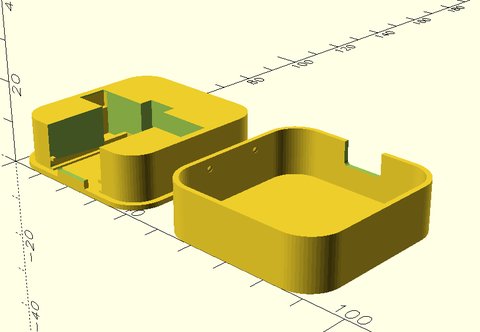
I had GPT 6 Astra design a little enclosure for a presence sensor I'm making, without writing a line of code or touching any CAD myself. I described what I wanted in a few messages and the first thing it generated already fit together, and after a few later iterations to change things it fits perfectly: the ESP, the sensor and the lid all press-fit together.

Stavros

30

Sky Team PCB: An Electronic Cockpit Panel for the Board Game

Nicolas and I are starting a project to build a PCB companion for the cooperative board game Sky Team, which was game of the year 2024. The plan is to recreate the game's cockpit elements in hardware — switches with their corresponding LEDs, plus some LEDs that act as counters. The first step is simply getting hold of a copy of the game: Amazon.de doesn't carry it and Amazon isn't really a thing in Switzerland, so Nicolas tracked down the original French edition and is picking it up from a store in Zurich. Once he's had a chance to play it and the requirements stop being abstract, we'll brainstorm the design together. Right now we're focused on figuring out how to connect everything; the software can come much later.

Stavros

19

ESP32 voice recorder for quick notes

I built a small ESP32 based voice recorder so I can take notes quickly: I press a button, it records audio, and when I am near a PC it transfers the audio over Bluetooth and transcribes it automatically. Startup is instant, and the Bluetooth transfer ended up very reliable and fast. The one thing still fighting me is the power side, where the MOSFET that is meant to cut all the power off does not do its job.

Stavros

18

WiFi-driven analog clock from a cheap movement

I set out to convert a cheap analog clock so it could be driven over WiFi, inspired by a couple of existing projects. My first attempt seemed broken because the second hand crawled around a degree at a time, so I eventually gave up on it and bought a second clock. Putting a battery in that one first revealed the real problem: the movement sweeps rather than ticks. I pulled the old clock's circuit back out of the trash, measured it on an oscilloscope, replicated the pulse pattern in firmware, and got it working.

Stavros

15

A Compact Two-Colour Case for Milwaukee Screwdriver Bits

I bought a set of Milwaukee screwdriver bits — which are apparently the best bits in the universe, because I love them already — but the case they came in was pretty massive. So I designed a much smaller replacement case, with embossed lettering flood-filled in a second colour, and printed it on my Bambu printer. The main obstacle was my AMS, which had broken down and left me unable to print the white part; I looked into manual filament swaps in the slicer, worked out I'd need four of them, and considered splitting the design into two glued models instead. In the end the AMS worked long enough to get the print done, and I love the result — though I did forget the chamfer, so it may yet get reprinted.

Stavros

10

Switch-and-LED Puzzle Box: Working Out How to Drive the LEDs from a Pico

I'm building a switch-and-LED project where flipping switches lights up LEDs, but where something also has to count the switches and turn other LEDs on or off — so an MCU is in the picture. I started a thread to ask whether I could cut down the pin count by leaning on the fact that the switch just needs to drive its own LED most of the time, which would free up about 10 GPIOs. The discussion that followed talked me out of that shortcut and into wiring the LEDs to GPIOs anyway, so I get animation and PWM control, and it introduced me to the RP2040's configurable GPIO drive strengths as a possible way to skip per-LED resistors. My current plan is to test on the bench, starting at the lowest drive strength and working up, with a small resistor in place as a safety net while I experiment.

Stavros

07

The Exelixi Macropad: A Layer Dedicated to Motivational Nonsense

I absolutely love my macropad, and I've just given it a new purpose: an entire layer dedicated to a Greek-American influencer/hustler/idiot guy whose quotes are so ridiculous they deserve dedicated hardware. Press a button, and out comes "nootropia type shit bro" or "exelixi bro, open the fuckin pita." It's been so much fun that I've decided everyone needs one, so I'm getting a batch of PCBs made to send around to friends.

Stavros

06

Squeezing a Dense PCB Into a Compact Two-Board Stack

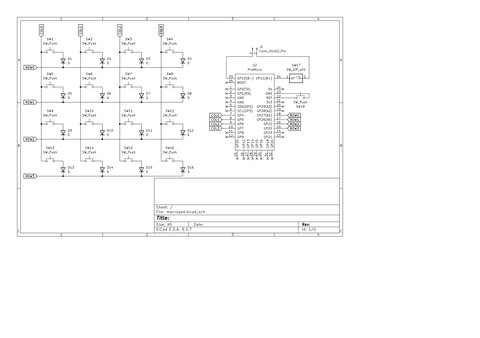
I set out to lay out a PCB from my schematic in as compact a footprint as possible, which turned out to be the hard part of the whole project. The density made routing a real fight — I trimmed the design down by removing pins I didn't need, and split the circuit across two boards connected by headers to take advantage of the vertical space I had available. Even then, the second board was dense enough that I struggled to route its pins, and for a while I wasn't sure it would fit at all. I eventually found a solution, and the plan is to finish routing and order a few boards.

Stavros

02

White filament LED diffuser at 0.6 mm

A thin printed diffuser made from plain white filament, printed 0.6 mm thick so the individual LEDs underneath stay hidden without the light being softened too much. Nicolas asked about it in the thread and plans to try something similar over a Pico Unicorn Pack.

Stavros